GREB-ISM
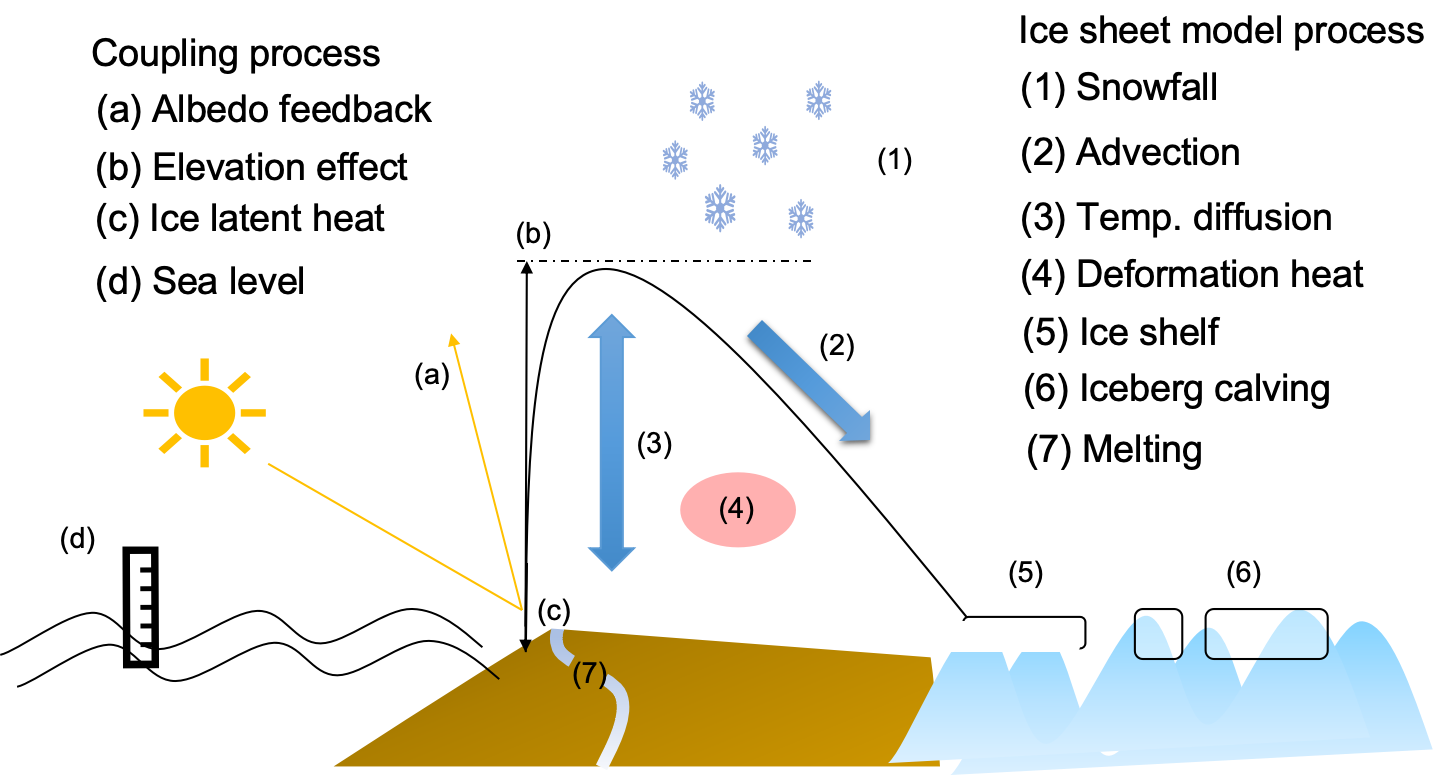
The Globally Resolved Energy Balance – Ice Sheet Model v1.0 (GREB-ISM v1.0) (Xie et al., 2022) is a fully coupled global ice-sheet–climate modeling system capable of simulating the evolution of grounded ice sheets and floating ice shelves on a global grid. The model explicitly accounts for interactions with key climate components, including surface temperature, snowfall, albedo, land–sea distribution, topography, and sea level.
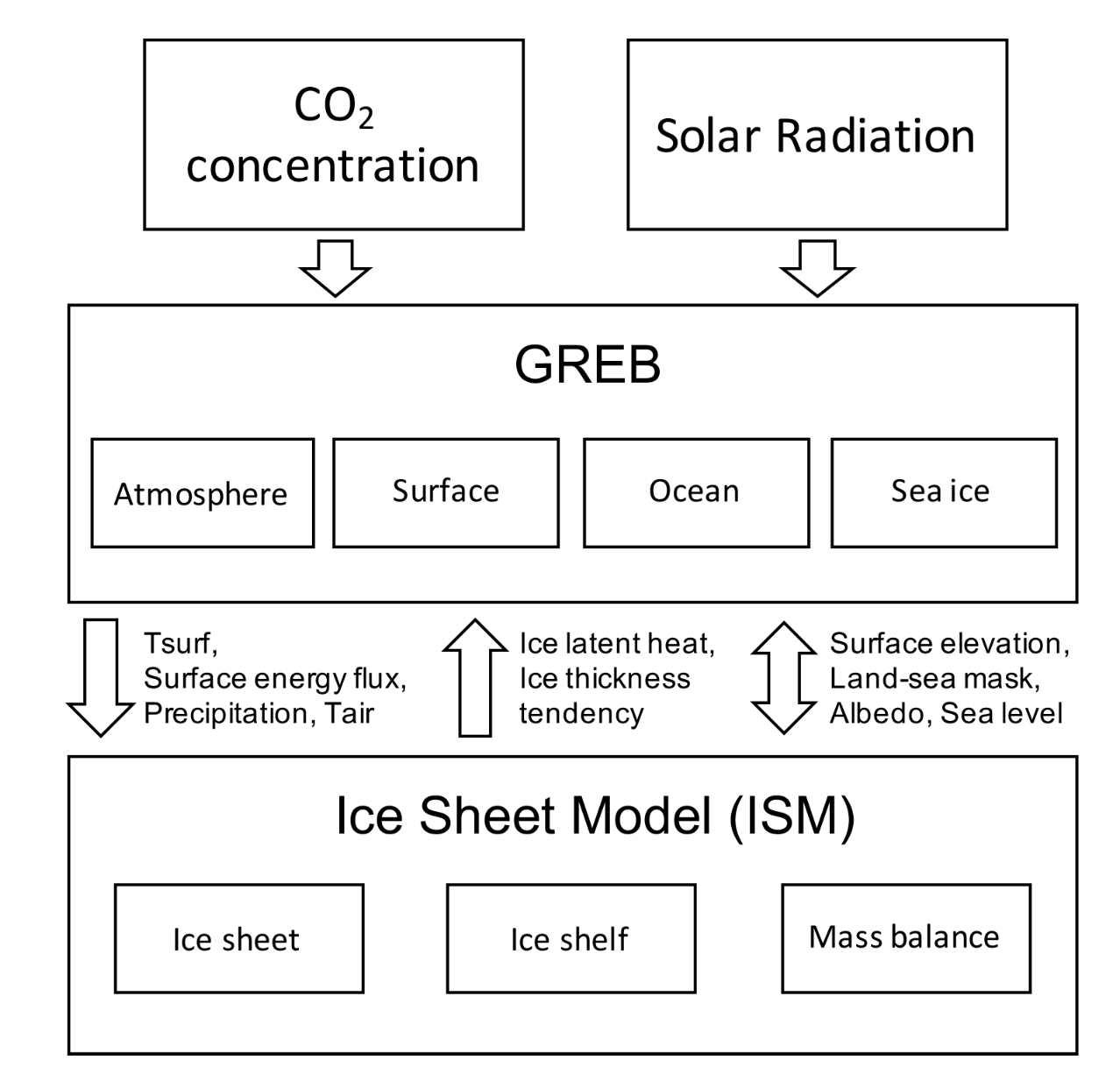
GREB-ISM is integrated with the Globally Resolved Energy Balance climate model v2.0 (GREB v2.0) (Dommenget & Flöter, 2011; Stassen et al., 2019), which represents the climate system using three physical layers — atmosphere, surface, and deep ocean — at a horizontal resolution of 3.75° × 3.75° (96 × 48 grid points). The GREB model also includes a simplified treatment of atmospheric water vapor based on evaporation, precipitation, and atmospheric transport. Precipitation is determined diagnostically following Stassen et al. (2019). Since GREB-ISM is a fast and efficient model, it is a suitable tool for paleoclimate simulation.
The ice-sheet module of GREB-ISM is a three-dimensional model with four vertical layers, using the shallow-ice approximation (SIA) for grounded ice and the shallow-shelf approximation (SSA) with constant viscosity for floating ice shelves. Surface melt rates are computed from the surface energy balance provided by GREB v2.0. Together, these components enable GREB-ISM to efficiently simulate long-timescale ice-sheet evolution and climate feedbacks on global scales.
Useful links
References
- Xie, Z., Dommenget, D., McCormack, F. S., & Mackintosh, A. N. (2022). GREB-ISM v1.0: A coupled ice sheet model for the Globally Resolved Energy Balance model for global simulations on timescales of 100\,kyr. Geoscientific Model Development, 15(9), 3691–3719. https://doi.org/10.5194/gmd-15-3691-2022
- Dommenget, D., & Flöter, J. (2011). Conceptual understanding of climate change with a globally resolved energy balance model. Climate Dynamics, 37(11–12), 2143–2165. https://doi.org/10.1007/s00382-011-1026-0
- Stassen, C., Dommenget, D., & Loveday, N. (2019). A hydrological cycle model for the Globally Resolved Energy Balance (GREB) model v1.0. Geoscientific Model Development, 12(1), 425–440. https://doi.org/10.5194/gmd-12-425-2019